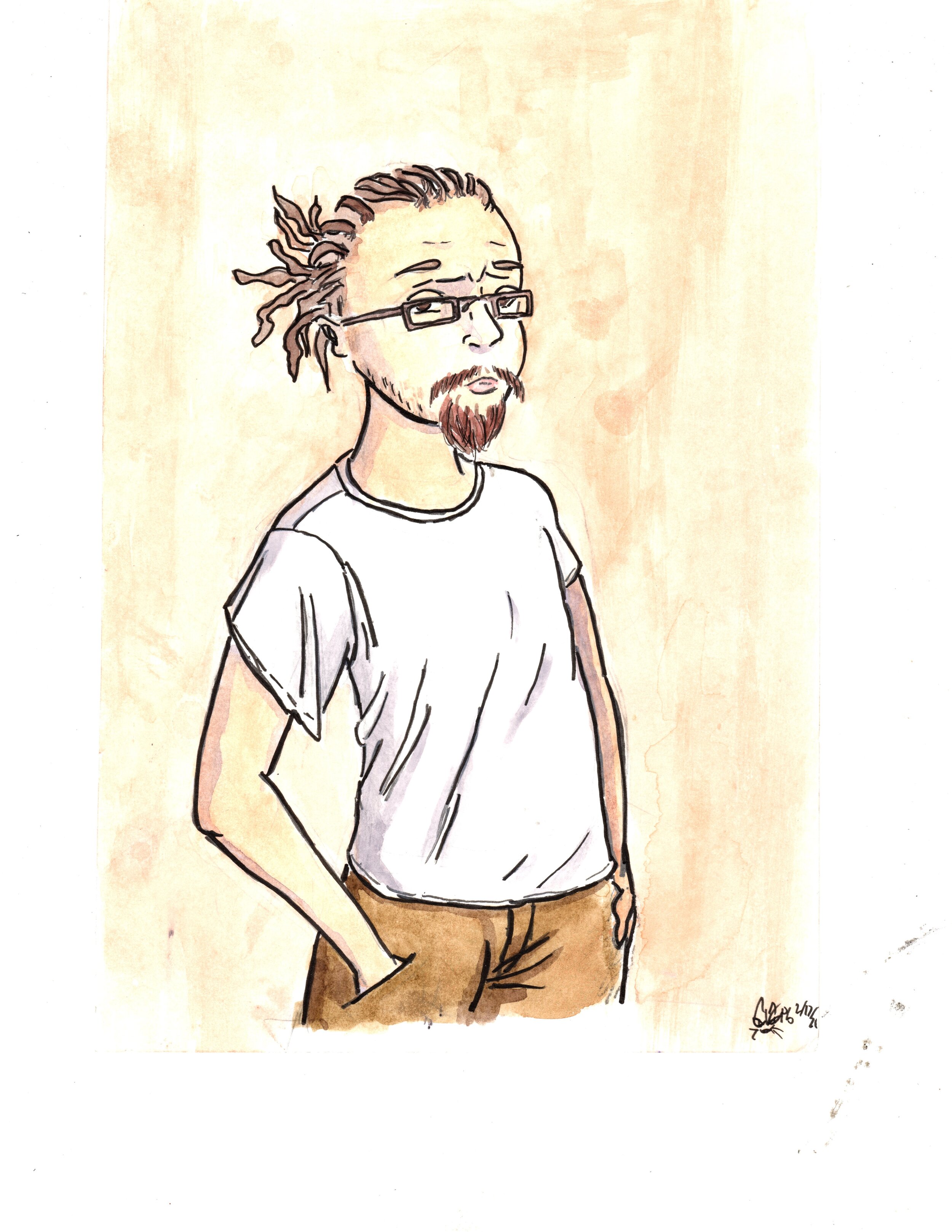
I feel compelled to depict an adult Spinelli smacking Gretchen on the ass ( wearing the same outfit as in the show ) ... people just don't understand my culture or my recent ideas ( but not all the ideas of the last month , like I left out the Velma one, just the ones from a few days ) a story where a guy invites his neighbor over for what he thought would be hot dogs but in fact it is hot dog, a spicy kebab of actual dog meat a story where I'll use my knowledge of ethnobotanical anthropology to show how mystical traditions develop around a plant found by colonists on a new planet - the first generation of settlers is scientifically advanced and first we read about Dr Dingus recording notes about chemicals analogous to earthly alkaloids found in local fauna, some with psychotropic properties, others medicinal. But subsequent generations focus on agriculture and so the colony becomes more primitive ( a common trope but a logical one for the colonization story ). We see how the fauna are used for medicine that becomes increasingly more folk , and how the community’s understanding of the ethnobotanicals discovered by the first colonists begins to tilt more towards an " unscientific " way of understanding them. The story is used to explore the reasons shamanic* practices and beliefs arose around ethnobotanicals on earth, by how they are shown to arise on this colony - going in reverse from a scientific to symbolic because that is where we are in this level of reality. I think " why did the huichol do this /that ? The shipibo ? " (By the way a shipibo patterned carpet would be great ). I think why did the people of the Orinoco river and the Tarumahara do things this way? In the story we have to show how special something like lophophora is to a person living in a world of unknowns .... That is why the colonist narrative. When the aboriginal Americans discovered lophophora , anedenthera, brugmansia - all the greatest plants are american ... When they discovered them they still lived in a world of mystery. The people in the story are colonists, so they have a chance to develop that natural understanding of ethnobotany - [ " I'm not a wizard or a warlock, or a shaman or a druid - I'm an ethnobotanist " That's my spiritual tradition. American ethno botanicals ] - because they're on the frontier of civilization. To understand how special those plants are and why they are sacred, they have to be looked at from the perspective of a human in the natural world before everything became global , before microscopes. That global perspective makes things look not as special as they are. But if we could see these plants from the perspective of an ancient human we’d understand why they are ... they are like as important as the sun and moon to primitive man. Those plants , teonanacatl, literally godflesh ... they represent ALL plant life and its importance relative to humanity. And that's where the deep feeling of insignificance, of humbling before cosmic might, and of great power that we get when we use these plants in ceremony comes from. So we’ll use the colonist narrative to tell that story.
* dislike this word, it refers to Siberian culture and yet its become a byword